Compare plans and benefit strategies
Before enrolling in an insurance plan, make sure you understand your options and how to maximize your benefits.
How to think about your choices
Health insurance coverage through Thatch involves a set of related decisions:
- How you want to spend on healthcare—such as preferring lower monthly costs or cheaper copays and prescriptions
- Which doctors, hospitals, and prescriptions you access (in‑network or out‑of‑network)
- How to use your employer’s allowanceallowance The amount an employer makes available to help employees pay for coverage or eligible expenses.—for premiums, for qualified medical expensesqualified medical expense A type of healthcare cost that counts as eligible for specific plans or accounts. (QME), or a combination
Thatch doesn’t just present you with plans to choose from. Thatch structures its presentation to provide true apples-to-apples comparisons.
You can only use your Thatch allowanceallowance The amount an employer makes available to help employees pay for coverage or eligible expenses. on QME if your employer enables this functionality. You can ask your employer directly about this, or use Ask Thatch to find out.
Your Thatch allowanceallowance The amount an employer makes available to help employees pay for coverage or eligible expenses.
Your employer sets a healthcare allowanceallowance The amount an employer makes available to help employees pay for coverage or eligible expenses. for you. This is the maximum amount your employer contributes toward your heathcare each month.
When you select a plan through Thatch, your premium is paid using your Thatch allowanceallowance The amount an employer makes available to help employees pay for coverage or eligible expenses.. If you choose a plan that exceeds your budget, your employer deducts the remaining amount from your paycheck.
When comparing plans in Thatch, you’ll usually see:
- The Thatch allowanceallowance The amount an employer makes available to help employees pay for coverage or eligible expenses. assigned to you (and how dependents affect this amount, if at all)
- How different plan choices use that allowanceallowance The amount an employer makes available to help employees pay for coverage or eligible expenses.
- Whether a given plan choice:
- Fully fits within your allowanceallowance The amount an employer makes available to help employees pay for coverage or eligible expenses.
- Requires additional contributions
- Leaves an unused balance that could fund other eligible benefits such as dental and vision coverage or QME purchases
This approach allows you to calculate your total health care strategy, instead of focusing solely on the premiums.
Thatch's Smart Budget tool
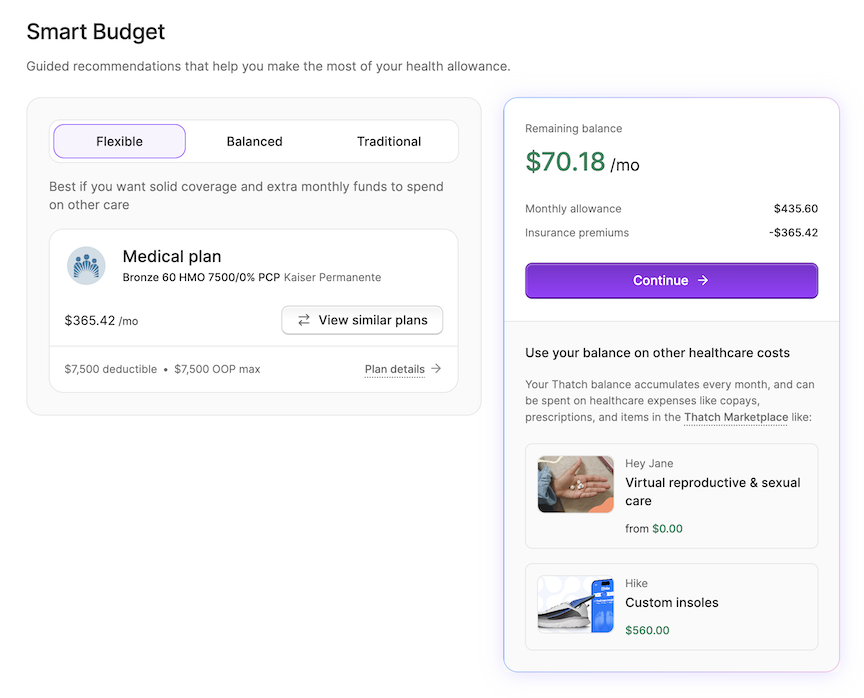
For previous employers, you probably only had one or two plans to choose from, not dozens as you might with Thatch. To simplify the decision-making process, you'll see the Smart Budget tool in the dashboard.
The Smart Budget tool can present plans by strategy:
- Flexible, the 10 cheapest plans by premium, which makes more funds available for QME
- Balanced, the 10 plans closet to your allowanceallowance The amount an employer makes available to help employees pay for coverage or eligible expenses.
- Traditional, the 10 plans with the greatest coverage
Compare plans
Within the plan selection experience, Thatch typically:
- Groups options into strategies (for example, lower premiums or lower deductiblesdeductible The amount a patient pays out of pocket for covered services before the insurance plan begins to pay.)
- Shows side‑by‑side comparisons with:
- Estimated monthly and yearly costs
- Deductiblesdeductible The amount a patient pays out of pocket for covered services before the insurance plan begins to pay., out‑of‑pocket maximums, and common copays
- Network details and whether your preferred providers are in network
Thatch may ask you a few questions about expected usage—how often you go to the doctor, whether you have ongoing prescriptions, whether you prefer lower monthly costs or lower worst‑case costs. That information is used to highlight strategies that better match your situation.
If your employer offers dental and vision coverage through Thatch, you’ll see these plan options after you select your medical insurance.
In-networkin-network A provider that has a contract with the patient's insurance plan. Visiting in-network providers typically costs less than going out-of-network. and out-of-networkout-of-network A provider that does not have a contract with the patient's insurance plan. Out-of-network care usually costs more and may not be covered at all by some plan types. considerations
Most medical plans distinguish between in‑network and out‑of‑network care. Thatch helps you:
- Search for doctors and facilities you already use
- Check whether they’re in network for each plan
- See how that status affects your likely costs
If you want to continue using key medical providers, you can either rule out plans where those providers are out of network, or look for a plan where your remaining Thatch balance can offset your out-of-pocket cost. (If your employer allows you to use a Thatch balance.)
Filter and sort plans
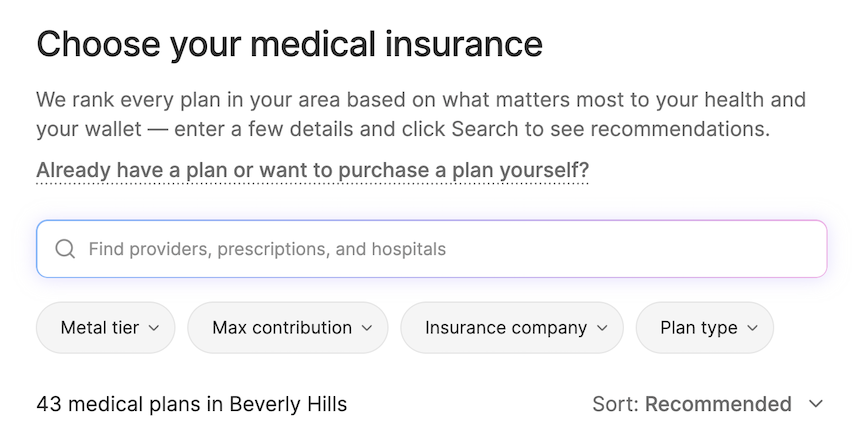
Use the filter options at the top of the Thatch dashboard to select the features that matter most to you. You can sort by
- Metal tiersmetal tiers Categories of health insurance plans—Bronze, Silver, Gold, and Platinum—that indicate how costs are shared between the patient and the insurance company. Bronze plans have lower premiums but higher out-of-pocket costs; platinum plans have higher premiums but lower out-of-pocket costs.
- Insurance companyinsurance company The company that provides insurance coverage. Also called an insurance provider. (perhaps you already know which one you want)
- Plan type, such as HMO or PPO
- How much you want to spend on premiums every month
Thatch uses your inputs to find matching plans.
Metal tiersmetal tiers Categories of health insurance plans—Bronze, Silver, Gold, and Platinum—that indicate how costs are shared between the patient and the insurance company. Bronze plans have lower premiums but higher out-of-pocket costs; platinum plans have higher premiums but lower out-of-pocket costs.—bronze, silver, gold, and platinum—are a standardized way to categorize how costs are split between you and your insurance companyinsurance company The company that provides insurance coverage. Also called an insurance provider.. A bronze plan has lower premiums but a higher cost when receiving care. A platinum plan has higher premiums but a lower cost when receiving care.
Use the sort options to sort the plans by:
- Recommended, Thatch tries to find you the best deals, like paying a few dollars more a month for a much lower deductibledeductible The amount a patient pays out of pocket for covered services before the insurance plan begins to pay.
- Lowest deductibledeductible The amount a patient pays out of pocket for covered services before the insurance plan begins to pay., plans where the insurance companyinsurance company The company that provides insurance coverage. Also called an insurance provider. pays out sooner
- Highest coverage, plans where you'll pay less at the point of servicePoint of Service A plan type that combines features of HMO and PPO plans. Patients need a referral from their primary care physician to see a specialist, but can go out-of-network at a higher cost. (such as $0 copays)
Bring Your Own Plan (BYOP)
When comparing plans, you'll also see a Bring Your Own Plan (BYPO) option. If you choose this option, instead of choosing from a list of possible plans, you’ll:
- Provide details about your existing coverage
- Review how BYOP affects your costs
If you're bringing your own plan, you can decide how you want to pay for it (ranked from easiest to more effortful):
- (Preferred method) Thatch generates a payment card for you to use, you add it to your insurance companyinsurance company The company that provides insurance coverage. Also called an insurance provider.'s autopay, and Thatch makes the monthly payments
- Thatch generates a bank account for you to use for ACH payments, similar to the card (only suggested if your insurance companyinsurance company The company that provides insurance coverage. Also called an insurance provider. doesn't accept debit card payments)
- You pay the premiums yourself as you previously have, then submit receipts of your premium payments to Thatch for reimbursement from your employer's allowanceallowance The amount an employer makes available to help employees pay for coverage or eligible expenses.
With all three options, the full premium amount should be paid. If this amount is more than your employer's allowanceallowance The amount an employer makes available to help employees pay for coverage or eligible expenses., the overage will be deducted from your paycheck.
A potential pitfall of BYOP is you must ensure the plan remains in good financial standing, and handle any coverage escalations directly with your insurance companyinsurance company The company that provides insurance coverage. Also called an insurance provider..
Next steps
After you’ve explored your options and understand the tradeoffs involved, enroll in a plan.